The two Jean Monnet Centres of Excellence at the University of Salento and the Federal University of Minas Gerais are consolidating their academic partnership to advance research on democracy, human rights and sustainable governance, while working towards greater visibility, accessibility and dissemination of their scientific results.
Academic cooperation between Europe and Latin America is taking on an increasingly important role in addressing shared challenges related to democracy, fundamental rights, sustainability and global governance. Within this context, the EUmanity Demos – Democracy for Europe and Humanity Jean Monnet Centre of Excellence, based at the University of Salento in Italy, and the Jean Monnet Centre of Excellence at the Federal University of Minas Gerais (CEJM-UFMG) in Brazil are strengthening their scientific collaboration and developing closer links between their research, teaching and dissemination activities.
Both Centres operate within the European Union’s Erasmus+ Jean Monnet framework, which promotes excellence in European Union studies, international academic cooperation and the dissemination of knowledge about European integration.
Their partnership goes beyond participation in individual academic events. It is rooted in reciprocal involvement in scientific and teaching structures, shared research interests and a common commitment to making academic knowledge more accessible to institutions, policymakers, researchers, students and wider society.
A particularly important dimension of this cooperation is the ambition to enhance the dissemination and public impact of scientific results, ensuring that research findings, comparative analyses and educational resources circulate more effectively between European and Latin American academic communities and reach audiences beyond universities.
Two Centres, a Shared Scientific Vision
The Jean Monnet Centre of Excellence at UFMG has developed a significant academic trajectory in the field of European integration, international law, human rights and sustainability.
Its origins can be traced back to 2014, when Jean Monnet activities at the university began under the leadership of Professor Jamile Bergamaschine Mata Diz, who subsequently founded and directed the Centre, officially established in 2019.
Over more than a decade, Professor Mata Diz has contributed to the development of an international scientific network connecting Brazilian and European scholars, with particular attention to relations between the European Union and Mercosur, sustainable development and the international dimensions of European governance.
The Centre is now entering a new phase under the direction of Professor Carla Ribeiro Volpini Silva, following the European Commission’s approval of its third Jean Monnet Centre of Excellence project.
This transition combines continuity with renewal, building on the scientific foundations established by Professor Mata Diz while opening further opportunities for international collaboration.
The relationship with EUmanity Demos represents an important component of this international outlook.
Based at the University of Salento and directed by Professor Susanna Maria Cafaro, EUmanity Demos brings together academic expertise in European integration, democracy, institutional governance, fundamental rights and the relationship between European and global democratic processes.
The complementary expertise of the two Centres creates opportunities for comparative research and interdisciplinary dialogue, particularly in areas where European and Latin American experiences can provide different but mutually enriching perspectives.
Reciprocal Academic Participation as a Foundation for Cooperation
A distinctive feature of this partnership is the direct involvement of scholars and experts from both institutions in their respective academic structures.
Professor Susanna Maria Cafaro and Professor Saverio Di Benedetto, from the University of Salento, are members of the teaching faculty of the Jean Monnet Centre of Excellence at UFMG. Luca Sanna, a European project management and communication specialist, is also part of the Brazilian Centre’s teaching network.
At the same time, Professors Jamile Bergamaschine Mata Diz and Carla Ribeiro Volpini Silva are members of the Scientific Committee of EUmanity Demos.
This reciprocal participation creates a framework for continuous academic exchange, allowing researchers to share methodologies, identify common research priorities and contribute to each other’s educational and scientific initiatives.
It also encourages the development of a shared intellectual environment in which questions concerning democracy, human rights and European integration can be examined from both European and Latin American perspectives.
Rather than treating international cooperation as a series of isolated events, the relationship between the two Centres provides a basis for sustained collaboration in teaching, scientific dialogue, comparative analysis and the communication of research findings.
From Research Cooperation to Effective Knowledge Dissemination
One of the most promising aspects of the partnership concerns the dissemination of scientific results.
Research on European integration, democratic governance and fundamental rights often produces findings of relevance beyond the academic community. Such knowledge can inform public debate, contribute to institutional learning and support a better understanding of complex political and legal developments.
However, its impact also depends on the ability to communicate research outcomes clearly, make them accessible and reach audiences in different countries and linguistic contexts.
In this regard, the collaboration between EUmanity Demos and CEJM-UFMG aims to support a more coordinated approach to scientific communication and dissemination.
The two Centres can benefit from their complementary networks, academic expertise and communication capacities to increase the visibility of research activities and ensure wider circulation of their results.
Potential areas for enhanced cooperation include joint scientific publications, the exchange and dissemination of educational materials, coordinated communication about research initiatives, and the development of accessible content presenting academic findings to non-specialist audiences.
International seminars, conferences and teaching activities can also generate opportunities for further dissemination through articles, interviews, thematic reports and digital communication channels.
The shared objective is not only to produce and exchange knowledge, but also to improve its visibility, accessibility and capacity to contribute to public understanding and institutional debate.
This approach is consistent with the wider mission of the Jean Monnet programme, which encourages dialogue between academia and society and supports the international dissemination of knowledge about the European Union.
The Belo Horizonte Seminar: Democracy and Human Rights in Global Perspective
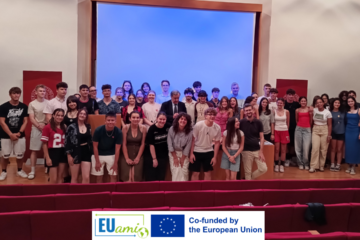
The scientific cooperation between the two Centres was recently illustrated by the international seminar “Democracy and Protection of Human Rights: European Union Values and External Values”, held from 22 to 24 September 2026 at the Faculty of Law of the Federal University of Minas Gerais in Belo Horizonte.
The event brought together academics and institutional representatives from Brazil, Europe and other Latin American countries to examine contemporary challenges to democracy, the rule of law and international systems of human rights protection.
The programme addressed global governance, sustainability, regional integration, relations between the European Union and Mercosur, and the international protection of fundamental rights.
A significant contribution came from Professor Susanna Maria Cafaro, Director of EUmanity Demos, who participated in the panel on “Global Governance and Sustainability: New Agendas and New Challenges”.
Her participation provided a concrete example of the scientific exchange between the two Centres, bringing European academic perspectives into a broader discussion involving scholars and institutions from Latin America.
The seminar also demonstrated the importance of creating international spaces in which research findings and different institutional experiences can be compared, discussed and subsequently shared with wider audiences.
By connecting scientific debate with international dissemination, events of this kind can contribute to strengthening research networks and increasing the circulation of knowledge beyond the institutions directly involved.
From Belo Horizonte to Lecce: Expanding the International Dialogue
The partnership was further reflected in the Italian-Brazilian Seminar on Law and Public Oversight – “Institutions, Governance and Public Value: From Local to Global”, held in Lecce from 27 to 30 October 2026.
The initiative, supported by EUmanity Demos and involving the Jean Monnet Centre at UFMG, brought together academics, representatives of Brazilian Courts of Accounts and international experts.
Discussions explored public accountability, sustainable development, environmental protection, digital transformation, artificial intelligence, civic participation and institutional innovation.
The seminar concluded with the adoption of the Lecce Charter, establishing shared priorities for strengthening public oversight, institutional cooperation and the creation of public value.
Held just over a month after the Belo Horizonte event, the Lecce seminar highlighted the continuity of scientific exchanges between Brazilian and European academic networks.
Together, these initiatives demonstrate how international academic cooperation can connect research with institutional practice, while generating scientific content and outcomes that can be disseminated to wider audiences.
They also illustrate the importance of building communication and knowledge-sharing activities around international scientific events, ensuring that their relevance extends beyond the days on which they take place.
Strengthening the International Reach of Jean Monnet Research
The collaboration between EUmanity Demos and CEJM-UFMG offers an opportunity to strengthen the international visibility and impact of their respective scientific activities.
Their shared academic networks can facilitate the circulation of knowledge between Europe and Latin America, encourage dialogue between different research traditions and contribute to the dissemination of European Union studies in a broader international context.
At the same time, closer cooperation in scientific communication can help ensure that the results of research projects are available not only to specialists but also to students, public administrations, civil society organisations and citizens interested in the future of democracy and European integration.
This means considering dissemination not simply as a final stage of academic work, but as an integral component of scientific cooperation.
By combining research expertise, international partnerships and communication capacities, the two Centres can contribute to a more connected and accessible scientific environment.
A Lasting Partnership for Research, Democracy and Public Engagement
The relationship between the Jean Monnet Centres of Excellence at the University of Salento and the Federal University of Minas Gerais reflects a common vision of academic cooperation as a means of connecting knowledge, institutions and societies across geographical boundaries.
The reciprocal involvement of their academic communities, the continuity of their international exchanges and their shared interest in communicating research results provide a strong foundation for future joint activities.
For EUmanity Demos and CEJM-UFMG, the next step is to further develop this scientific relationship, combining research excellence with greater attention to knowledge dissemination and public engagement.
The partnership demonstrates that the value of international academic cooperation lies not only in producing new knowledge, but also in making that knowledge accessible, sharing it across borders and enabling it to contribute to wider debates on democracy, rights and sustainable governance.
By strengthening both scientific collaboration and the dissemination of research outcomes, the two Jean Monnet Centres aim to build a lasting bridge between Europe and Latin America, contributing to a more informed and interconnected international academic and civic community.